
Continuously Assuring What Matters
CFA helps enterprises identify financial risks, transaction anomalies and control breakdowns through continuous, rule-driven assurance of financial data.
Why Continuous Financial Assurance Matters
Enterprise financial data spans large volumes of transactions, vendors, invoices, payments and journal entries. Periodic reviews and manual checks may not consistently identify every exception or control gap. Organizations need a systematic way to examine financial activity, identify potential risks and direct attention where it matters most.
Financial Exceptions
Duplicate or excess payments, unusual transactions and inconsistent financial records can require detailed analysis to uncover.
Periodic Review Gaps
Periodic reviews can leave gaps between review cycles, making it harder to maintain a consistent view of emerging financial exceptions.
Investigation Priorities
Finance and audit teams need useful evidence and risk-based prioritization to focus investigation on the exceptions that warrant attention.
How Continuous Financial Assurance Works
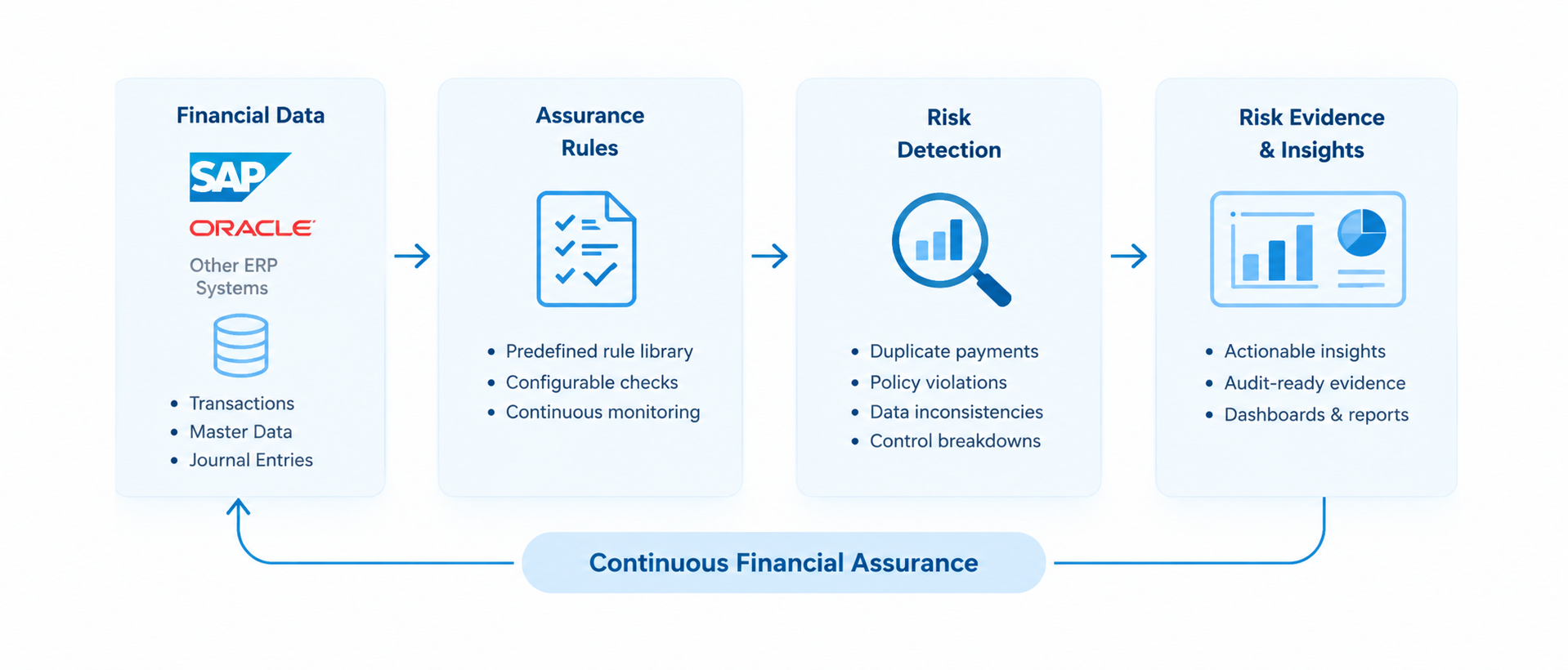
CFA transforms financial data into actionable assurance evidence through a structured, rule-driven process. It examines financial activity, identifies potential exceptions and helps teams focus their attention on risks that matter.
Financial Data
CFA uses financial transaction data and relevant vendor, invoice and journal information extracted from enterprise systems.
Assurance Rules
Defined, rule-driven checks examine financial activity to identify potential exceptions, inconsistencies and control breakdowns.
Risk Assessment
Identified exceptions are assessed and prioritized to help finance and audit teams focus on issues that warrant attention.
Risk Evidence
CFA presents supporting details for identified exceptions, helping finance and audit teams understand the issue and investigate it further.
Financial Assurance Scenarios
CFA applies rule-driven checks to financial activity to help identify potential exceptions, inconsistencies and financial control weaknesses. Its assurance capabilities are expanding progressively, starting with selected payment-related risks.
18+ assurance rules across 4 financial risk scenarios.
Continuously researched and progressively expanded.
Duplicate Invoice & Payment Risks
Repeated invoices, invoice-reference variations and payments made more than once against the same obligation.
Excess & Fragmented Payments
Potential overpayments, cumulative partial payments exceeding invoice values, and repeated payment patterns.
Vendor Master & Payment Detail Risks
Potential duplicate vendor records, inconsistent vendor details and shared bank-account information that warrant review.
Payment Processing Exceptions
Duplicate payment-run entries and reversal-related inconsistencies that may create duplicate-payment exposure.